
Your Cart
Sushi Containers With Lids: Why the Lid Is the Hard Part of Switching From PS to PET
Ask anyone who has switched a sushi line from PS to PET what actually went wrong, and the answer is rarely the base tray. The base is a shape; it forms the same way in almost any material. What fails is the lid — locks that no longer snap, fog that appears over the rice by hour two, lids that lift off a stack that used to hold.
This matters right now because the switch is no longer optional for many markets: PS is falling out of favor with retailers and recyclers, and PET/rPET fits the recycling streams that buyers are increasingly audited against. But a sushi container with lid is a mated system, not two separate parts. This article explains why the lid is where material switches go wrong — and gives you the validation checklist that catches it before mass production.
The Lid Is a Precision Part, Not a Cover
A sushi lid is formed to engage a specific flange: the bead geometry, the undercut depth, the wall stiffness at the snap point. All of that is tuned to one material's behavior. Change the material and every one of those numbers moves:
Stiffness and memory differ. PS and PET do not flex the same way. A lid designed in PS may snap onto a PET base with a different engage force — sometimes so loose it rattles off, sometimes so tight the line crew dents trays forcing it closed. Neither failure shows up on a drawing.
Cold behavior differs. Sushi lives in refrigerated cases. Materials that behave identically at room temperature diverge at 4°C: stiffness rises, snap engagement changes, and a lock that felt secure on the packing bench can feel loose on the shelf.
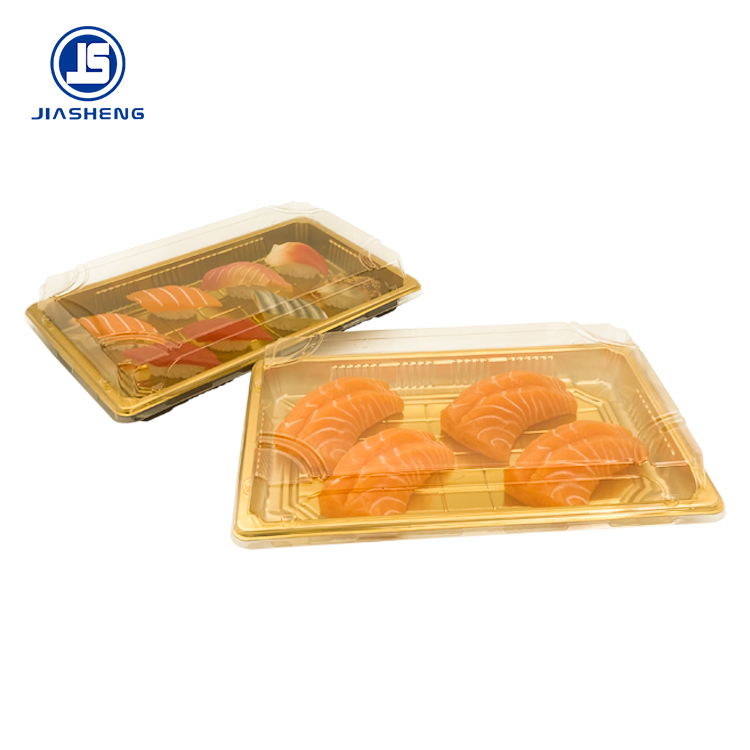
Clarity is not automatic. The same lid design can look glassy in one material and hazy in another, and anti-fog additives that worked in the old material may not be compatible with the new one. The photo below is the standard the shelf demands — product visible, lid clear, no condensation film between customer and food.

This is why the honest answer to "can we keep the same design, just in PET?" is: not without re-validating the pair. Formats like our leak-resistant sushi container with lid were developed as base-and-lid systems in one material — which is exactly the point. The pair is designed and tested together, not assembled from parts that happened to fit.
What Actually Changes When You Switch: Base Easy, Lid Hard
The asymmetry is worth spelling out, because it decides where your sampling budget should go:
The base is the easy half. A base cavity that holds nigiri holds nigiri in any clear rigid material. Wall thickness may need a tweak — PET typically runs slightly different gauge for the same rigidity — but the geometry transfers. Most suppliers can show you a working PET base within a round or two of samples, and food-contact documentation for grades like those in our food-grade sushi box range is routine.
The lid is the hard half. The lid has to mate, lock, stay locked through a refrigerated supply chain, stay clear above moist rice, and stack under other trays. Each of those is a material-sensitive behavior. If your sampling plan tests three base prototypes and one lid "assumed to carry over," you have spent your budget on the easy problem.
Anti-Fog: Sushi Is the Worst Case, So Test It Like One
Fresh rice gives off moisture continuously; the case runs cold; doors open and close all day, cycling the temperature. Condensation forms on the inside of the lid — and once it beads, the product looks tired no matter how fresh it is. Anti-fog performance is where PS-to-PET switches most often surprise buyers, because the additive systems differ between materials and a coating that performed in one can underperform in the other.
Test the way the product actually lives: pack real sushi, lid on, into a refrigerated case at retail temperature, and check the lid at two, six and twenty-four hours. A data-sheet anti-fog rating measured at ambient tells you nothing about hour six above a moist rice bed. This single test catches more launch failures in sushi packaging than any other — and it costs one afternoon.
The Lid Validation Checklist
Run every item on the actual base-and-lid pair in the new material, never on mixed old/new samples:
1. Engage and retention force. The lid should snap with an even, auditable force — and resist peel-off from the corners. Test cold as well as ambient; engagement changes at case temperature.
2. Anti-fog under real conditions. Real product, real case temperature, timed checks over 24 hours, as above.
3. Stack and crush with lids on. Delivery stacks trays on trays. Lock the lids and load the stack to your real transport height — the load path now runs through the lid, and a lid that flexes under load pops its neighbors' locks. The ribbed flange visible on trays like these disposable sushi containers with lids is what carries that load; verify it still does in the new material.

4. Leak check with sauced products. If the tray carries dressed items, tip and transport-test with real sauce. Leak resistance comes from the lid-to-flange interface — the exact geometry your material switch just changed.
5. Line trial. The new pair must run through your existing closing equipment at production speed. A manual-snap success is not a machine-snap success.
6. Compliance paperwork for the new material. Food-contact documentation, recycling-stream fit, and any market-specific rules — re-issued for the new material, not inherited from the old one.
Four Questions to Ask Before You Commit to a Switch
1. Is the lid being re-tooled or carried over? A carried-over lid mold from a different material family is a warning sign, not a saving. Ask what changes were made and why.
2. How was anti-fog validated, and at what temperature? You want "packed real product at case temperature for 24 hours," not a datasheet value.
3. What is the stack rating with lids engaged? Give them your real pallet and delivery-stack pattern; ask how it was tested.
4. Can we run a fitted sample before tooling? A supplier confident in the pair will put a physical base-and-lid sample in your hands — free sample services exist precisely for this decision. If you are new to lid and lock vocabulary, our guide to clamshell styles, locks and uses covers the closure types you will meet in quotes.
Frequently Asked Questions
Can we reuse our existing PS lid tool for PET? Occasionally, with modifications — but treat it as a new part until the full checklist passes. Shrinkage and flex behavior differ enough that "same tool, new material" usually needs adjusted bead depths or flange dimensions.
Is PET actually more expensive than PS once switched? Per unit, slightly; per complaint, usually cheaper. Material cost is a fraction of the landed cost of a sushi pack, and PET's recycling-stream acceptance is increasingly a market-access requirement rather than a preference.
Does rPET fog more than virgin PET? Not inherently — clarity and anti-fog depend on the grade and additive system, not the recycled content alone. Ask for anti-fog validation on the specific rPET grade being quoted.
We use film-sealed trays, not snap-on lids. Does this apply? The principle does: sealing behavior is material-sensitive too. Verify seal strength and peel consistency on the new base web before committing — the failure mode just moves from the snap to the seal.
How long does a proper lid validation take? The physical tests are days, not weeks; sampling rounds dominate the calendar. Starting with a supplier who already runs the pair in the new material — rather than converting an old design — is usually the fastest and cheapest route.
The Bottom Line
A sushi container with lid is one system wearing two parts. When the industry moves from PS to PET, the base will transfer almost by itself — the lid will not. Put your sampling budget where the risk is: validate lock force, anti-fog, stack behavior and leak resistance on the real pair, cold, with real product. Do that and the material switch becomes what it should be — a packaging upgrade, not a season of shelf complaints.
Planning a PS-to-PET Switch for Sushi Packaging?
Send us your current tray dimensions and target material — we will check existing base-and-lid molds first and quote both routes.
Get a Sushi Tray Quote